
As the season gets underway I felt like putting together my opinion as to an all-time Reds team. My rules for making the team are simple. You had to play for the club for at least three years. There is one caveat…actually two…to that rule that will be explained when we get to their names. In putting together the team I tried to eliminate my personal biases and rely on objective facts…such as giving preference to Reds in the National Baseball Hall of Fame…then to national award winners such as MVPs. I tried to avoid using WAR because frankly I’m not a big fan of it. But because pitching stats have become a controversial point these days I will mention WAR for pitching purposes. I built the team as if I was putting the best 25 players to start for a season. I limited myself to a 10 man pitching staff (5 starters, 5 relievers). So here it goes starting with the 8 position starters:
C-Johnny Bench(1967-83)

Arguably the greatest catcher in baseball history so kind of an obvious choice. From his callup in late 1967 until he retired in 1983 he was one of the two faces of the franchise as the Reds moved from the Crosley Field era into Riverfront Stadium. A two time National League MVP, 10 time Gold Glove winner, 14 time All Star and a 1989 inductee into Cooperstown. He was the MVP of the Reds’ 1976 World Series sweep of the Yankees. His was the first number of a Reds player that was officially retired by the club. At the time he retired he had more career home runs than any other catcher in baseball history. He is author of some of the most dramatic HRs in Reds history. In the 5th and final game of the 1972 NLCS at Riverfront against the Pirates, Bench’s 9th inning HR off Dave Giusti tied the game setting up the Reds’ heroics that would follow. In game 2 of the 1975 World Series Bench’s opposite field shot at Fenway Park keyed a Reds comeback that tied the series at a game apiece. In game 3 of the 1976 NLCS at Riverfront against the Phillies, Bench was part of a back to back HR binge that tied the game in the 8th inning as the Reds went on to sweep the Phillies. His home run on Johnny Bench Night in September 1983 against the Astros also ranks as one of the most memorable homers in Reds history. Lets not forget that cannon of an arm that made baserunners think twice..and then a third time…about trying to steal a base. The most remarkable thing about number 5 to me is the 1972 season when he won his second NL MVP. He put up those numbers while being aware that x-rays had revealed a spot on his lung. So he played that season with the thought in his mind that it could be his last. A lot of people wouldn’t have been able to handle that kind of burden. He did. Thankfully, it turned out to be nothing and he went on to a long and storied career. Interestingly Johnny almost became the Reds owner. In 1984 Bench and his partner, A. Ray Smith of Louisville, thought they had a deal to buy the Reds from the Williams brothers. But the rules of the Reds partnership included a provision that the club had to be offered to the minority partners first. Thinking this a mere formality James Williams did just that during a Reds ownership meeting. To his surprise one partner put their hand up to accept the offer….Marge Schott. Who knows how different Reds history might be if Bench’s group actually bought the team.
1B-Tony Perez(1964-76,84-86)

Ahhh…this is the topic that seems to get the sabermetricians’ all bent out of shape. But very simply right now, based on his entire career as a Red, he is the best 1st baseman in club history. He was the glue that held the Big Red Machine clubhouse together. He was elected to Cooperstown in 2000. He was a 7 time all-star. His number 24 was retired by the Reds. What a lot of people don’t realize is that Perez starred for the Reds at both 1st and 3rd base. He was one of the most clutch hitters in team history. His home run in game 7 of the 1975 World Series against the Red Sox at Fenway Park off Bill Lee began the comeback that ended with the Reds first World Series title in 35 years. His hit in the 10th inning of game 2 of the 1976 World Series against the Yankees at Riverfront won the game as the Reds went on to sweep the series. That kind of clutch hitting is why Perez drove in more than 90 RBI for 10 straight seasons. Not an easy accomplishment in any era. He remains third all time on the Reds HR list. At the time he retired he held the record for most HR by a Latin American player. His 1192 RBI are the second most in Reds history behind his teammate Johnny Bench. Quite a career for a skinny kid from Cuba who had to leave his family behind in order to escape the Castro regime in one of the first waves of such refugees to hit the Florida beaches in the early 60’s. Seems fitting to remember his Cuban ties as we welcome another young Cuban to the Reds in season 150 in Yasiel Puig.
2B-Joe Morgan(1972-79)

Yes the Big Red Machine is dominating this starting lineup so far. And why not? They are one of the greatest teams in baseball history. And the arrival of Joe Morgan in Cincinnati is a big reason why this team finally achieved its’ glory. The greatest trade in Reds history wasn’t exactly hailed as such when Bob Howsam made the November 1971 trade with the Astros that Morgan to Cincinnati along with Jack Billingham, Dennis Menke, Cesar Geronimo and Ed Armbrister. Each one of those players made key contributions to the Reds pennant winning teams of the 70’s. But most fans were worried that Howsam had given the 72 pennant to Houston as he traded away the entire right side of the infield in first baseman Lee May and second baseman Tommy Helms. Morgan would almost immediately put those worries to bed as he led the Reds back to the playoffs in 1972. He was the National League MVP in both of the Reds World Championship years of 1975 and 76. He was an All-Star for his entire 7 year run as a Red. He also won the Gold Glove five times as a Red. His number 8 is another of the Reds’ retired numbers. He was inducted into Cooperstown in 1990. As a kid growing up watching the Big Red Machine, what made me appreciate Morgan probably more than the rest of the group was watching a guy who wasn’t very tall excel at this sport. Seriously Joe looked tiny next to the rest of those guys.
SS-Barry Larkin(1986-04)

The greatest shortstop in Reds history was actually born in Cincinnati. Actually in Silverton to be exact. The Reds wanted to get this home grown product so badly they actually drafted him twice. He finally signed the second time around. Barry was one of the best shortstops of his era. That his efforts were rewarded with election to Cooperstown in 2012 is a testament to just how good he was. A 12 time all-star, National League MVP in 1995, a 3-time Gold Glove winner and a 9 time Silver Slugger Award winner. He was also played a big role on the Reds 1990 wire-to-wire World Championship team. The Reds retired his number 11. He was also recognized for what he did off the field as the 1993 winner of the Roberto Clemente Award. Barry was one of the faces of the franchise as the Reds moved from the Riverfront Stadium era into Great American BallPark. For many years Barry was the team captain. He was a guy who understood very clearly his role as a native Cincinnatian playing for the Reds. He really epitomizes the Reds motto for 2019: “Born to Baseball”.
3B-Scott Rolen(2009-2012)

I know what you’re thinking…”he wasn’t with the Reds very long. How can he be the best third baseman in Reds history?” It’s a legitimate question. As I stated when I first put this thing together, we based this on the Reds HOF rules which state that a player must spend a minimum of three years on the team to qualify. Rolen fits that. He’s the only guy to specifically be inducted as a third baseman into Cooperstown to ever wear a Reds uniform. Perez went in as a first baseman. He was a significant reason, hell I could argue the biggest reason those Reds teams made the playoffs. He was a two time All-Star as a Red. Received votes as MVP for the 2010 season. You can make a strong case that he was and remains the best defensive third baseman in Reds history. Based on Baseball-Reference.com stats, Rolen was in fact still one of the best defensive third baseman in all of MLB during his time with the Reds. I haven’t even mentioned the fact that ANYONE who was around that team at that time will tell you about the HUGE impact Rolen made as a teammate off the diamond. That goes back to my previous point that without him those teams might not have gelled into the playoff teams they became.
LF-Frank Robinson(1956-65)

If not for the numbers Pete put up, Frank Robinson would be the greatest player in Reds history. If you really think about it, while those of us who grew up watching Pete play considered him the classic example of playing the hard nosed style we like to think of as Cincinnati baseball, the reality is that there is no bigger example of that style of play than Frank Robinson. This is a man who never gave an inch as a player. And it didn’t change after he retired. He wasn’t afraid to fight an opponent as guys like Eddie Matthews would find out. He also wasn’t afraid to dig in at the plate. He leaned over the plate essentially daring pitchers to hit him…and they did…A LOT. In six of his 10 years with the Redlegs, Frank led the league in being hit by a pitch. He always made the point that if a pitcher knocks him down, he’s going to have to throw the next one over the plate. That logic resulted in over 500 career homers for Robinson…324 of which came as a Red. He was the 1956 Rookie of the Year. His 1961 NL MVP season catapulted the Reds into the World Series for the first time since 1940. Here’s a fact for the stat geeks: His 1.015 OPS led the NL that season. In fact his OPS was above 1.000 three times as a Red. He was an all-star 8 times as a Red. He won a Gold Glove in 1958. Of course no mention of Frank as a Red would be complete without mentioning the fact he was part of the worst trade in Reds history when then Reds owner Bill DeWitt Sr. traded him to Baltimore for pitcher Milt Pappas and two others. He said Robinson was “an old 30”. Despite what he said there are a lot of people who believe Frank was traded because of a run in he had with Cincinnati cops where a gun was found in his car. Whatever the reason, he went on to have a triple crown season for the Orioles in 1966 and then got complete revenge when he helped Baltimore take out the Reds in five games in the 1970 World Series. His anger over that trade is a big part of why he went into the Hall of Fame as an Oriole. Fences were mended somewhat when the Reds retired his number 20 in the late 90’s. I mentioned his competitive spirit continued into retirement. A great example of that came in 1999. I was at WBOB we were putting together a list of the top 20 athletes of the 20th Century in Cincinnati sports. Frank came in 5th in the fan vote. I was the one who called him trying to get him to come on the air to talk about being one of the greatest players to ever play here. He asked me where he finished in the voting. I told him. He said “Fifth? No way!”. I may have cleaned it up a bit but it still shows the spirit and fire that drove this man to be one of the greatest Reds ever.
CF-Ken Griffey Jr.(2000-08)

I know what you’re thinking…how did he end up here? Because he deserves to be here. If we’re really being honest there was no way Junior would ever be able to live up to the hype that surrounded his coming to the Reds in 2000. We all assumed…including Junior…that coming here…to a hitter friendly park…would result in a lot of Reds wins as well as watching Junior break Hank Aaron’s HR record. OK we know that didn’t happen. The many, many injuries he suffered played a big role in that. But if you look back at when he wasn’t injured, Junior did produce. He still hit 210 HR as a Red which is 9th all-time in team history. He had a 40 HR season as well as two other 30+ seasons. He had an 100+ RBI season as well as 2 90+ seasons. He hit two significant career HR marks…numbers 500 and 600…as a Red. And if you really paid attention to Reds baseball in that era you’d know that, even in the years he was injured, his presence alone in the lineup was enough to make the Reds offense a much more potent weapon. He was inducted into Cooperstown and is a member of the Reds Hall of Fame as well.
RF-Edd Roush(1916-26,31)

Normally a center fielder, we moved him to right for the purposes of this team. Roush was undoubtedly the best Reds player of the pre-WW2 era. He was part of the Reds first World Championship team in 1919. That team doesn’t get the credit it deserves because of the Black Sox Scandal…even though that Reds team had a better record than the White Sox entering the series…but I digress. Roush was a two-time NL Batting champ as a Red. And he was no slouch in the field either. I mentioned earlier I’m not a big WAR fan. But to put Roush’s career in perspective his career WAR as a Red according to baseball-reference.com is 40.1. That’s pretty good. So that takes care of the starting eight.
DH-Pete Rose(1963-78,84-86)(1984-89 as Manager)

Yes here he is number 14. The greatest player in Reds history. Period. The biggest question with Pete was where to put him. He was Rookie of the Year in 1963 as a second baseman. That was his position for the 1964 Reds squad that missed the World Series by one game. He was the National League MVP as an outfielder…right fielder to be exact….in 1973. In fact six of his 10 200 hit seasons came as an outfielder. He became the All-time Hit King, which is the picture above, while playing first base(and managing) the Reds. The most significant years of Reds history occurred with him playing third base. The Reds won two World Championships. Pete was MVP of the 1975 Series. His aggressive tactics at 3rd base set the tone in the Reds sweep of the Yankees in the 1976 World Series. He joined the 3,000 hit club and went on his 44 game hit streak in 1978. Three of Pete’s 200 hit seasons came during this era. He also led the league in runs scored twice during this time as well as leading the NL in double three times while playing third. But at the end of the day he’s the HIT KING. And as much as HATE that the DH is now in the NL, it is clear that Designated Hitter is the best spot to place the HIT KING. No one has played in more games as a Cincinnati Red. Nor does any Red have as many hits or runs scored as Pete. 3,358 of Pete’s 4,256 hits came as a Red. While not the first Big Red Machine member to leave the Reds, Pete’s decision in November 1978 to sign with the Phillies was the most important defection as it signaled the beginning of the end of the dynasty as well as for a long time creating a simmering antipathy between fans and the club. An antipathy that was finally doused only by Pete’s return in 1984. In just the last few years MLB finally allowed the Reds to OFFICIALLY retire Pete’s number 14. Although the reality is that the late Bernie Stowe unofficially retired it in 1978. A fact made clear in 1990 when Lou Piniella joined the Reds and was told 14 was not available. Which of course brings us to the elephant in the room. Despite Pete’s banishment from baseball for gambling there is no doubt that he deserves to be on this team. While there have been some stories alleging he gambled on games as a player, the only evidence cited by baseball at the time of his banishment refers to the years Pete was managing the Reds. Besides, when you look at his numbers as a player it’s hard to believe he wasn’t trying to win games. Pete likes to say he played in more winning games than any player in MLB history. While I don’t know for a fact that that is true, his numbers would make you believe it. He’s not a member of Cooperstown(although he should be) but he is in the Reds HOF.
The Reserves
C-Ernie Lombardi(1932-41)
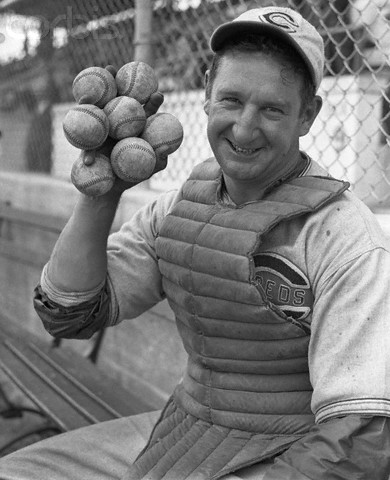
Ernie Lombardi was the best catcher to play in the first Century of Reds baseball. National League MVP in 1938. A 5 time All-Star as a Red and was part of the Reds 1940 World Championship squad. His career .311 batting average as a Red remains 5th all time which ties him with a group of Reds including one we’ll be talking about shortly. He was also one of the best defensive catchers of his era despite the fact he’s best remembered for “The Big Snooze” when he was knocked out cold covering the plate during the 1939 World Series against the Yankees. As the picture above suggests, he had huge hands. If that picture looks familiar, you’re right. Photographers later asked Johnny Bench if he could match the feat which he did. Ernie was inducted into Cooperstown in 1986.
1B-Joey Votto(2007-present)


Yeah you knew we were getting here at some point. The sabermetrics crowd would already say he should be the starting first baseman on this squad. I’m not there yet. I’m not saying I won’t come around to that as I continue to watch him. But not yet. And I’m going to use an argument that drives the stat geeks crazy. For a guy who hits in the middle of the lineup…specifically number 3…he doesn’t consistently drive in runs at a pace you’d expect. Votto has only driven in 90 RBI or more in 4 seasons. You’ll note I mentioned earlier Tony Perez…who generally hit 4th in the order…drove in 90 or more for 10 straight seasons. Votto’s lack of production in his Reds 3 postseason appearances is also concerning compared to how Perez came through in October. Having said all that this guy is still one of the two best first basemen in club history. He also already has the all-time best career OBP and OPS in Reds history. He’s the 2010 NL MVP, a 6-time All-Star and a Gold Glove winner.
Frank McCormick(1934,37-45)

He’s hands down the best pre-WW2 first baseman in Reds history. He was NL MVP in 1940 leading the Reds to a World Championship over the Tigers. He led the NL in RBI in 1939…part of a 3 year period where he drove in more than 100 RBI a year. He drove in 90+ RBI in five of his seasons with the Reds. He also set a record with 138 consecutive errorless games at first base. It’s amazing to think he might not have ever played in the majors. Three teams rejected him in tryouts. Then in 1928 he took a $50 loan from his uncle so he could travel to Beckley, West Virginia to tryout for the Reds. The rest, as they say, is history.
2B-Bid McPhee(1882-99)

The first of three pre-1900 Reds to make this list. McPhee was one of the best second basemen of his era. As the picture suggests, he did not play with a glove. The story goes that he toughened his hands up by soaking them in salt water. He was in fact one of the finest fielders of that era so maybe other guys should have tried that. He was a great hitter as well. He still holds the Reds career record for triples(188) and stolen bases(568). He remains second all-time in runs scored as well as RBI. He’s 4th on the Reds career hit list. In his rookie season he led the Reds to their first ever championship as they won the American Association title. Remember the Reds played in the rival AA in the 1880’s because the NL didn’t like the fact the Reds sold beer on Sundays at their ballpark. The Reds and a number of other AA teams rejoined the NL in 1890 to form the majority of what we now know as the National League. Bid was inducted into Cooperstown in 2000.
SS-George Wright(1869-70)

As I stated at the beginning of this blogpost there would be two caveats to my 3 year rule. I mean, c’mon, we’re celebrating the 150th anniversary of this franchise. How can you do that without including the founders of the Cincinnati Red Stockings? As his plaque in Cooperstown suggests, George Wright was the star of the world’s first fully professional baseball team. In that inaugural season of play for pay, George was the team’s highest paid player at $1400. He hit .633 and slugged 49 homers as the Red Stockings went undefeated in 57 games across the U.S. including a much publicized trip to the west coast. The team’s run continued for another 15 games in 1870 before their controversial loss to the Brooklyn Atlantics. Money problems would cause Wright and the other paid players to leave the Red Stockings shortly after that happened. If you haven’t read Greg Rhodes and John Erardi’s novel “The First Boys of Summer” I highly encourage you to do so.
OF-George Foster (1971-81)

He is the fifth cog in that Big Red Machine lineup of the 1970’s. And yet who knows if he would have ever achieved his stardom had it not been for Sparky Anderson’s gamble to move Pete Rose to 3rd base in May 1975. Foster responded by hitting 23 HR and driving in 78 runs for the 75 World Champs. But he really exploded the next season. From 1976-78 he would lead the NL in RBI with 121,149, 120 respectively. That 149 total was part of his 1977 NL MVP campaign in which he hit 52 HR. The 52 homers remain the Reds single season record. While his homer numbers fell off following the 1978 season, his RBI totals really didn’t. He drove in 90+ RBI every year from 1976-1981. That includes 90 in the strike shortened 1981 season. That feat frankly deserves much more admiration than it really gets. While he was famously quoted as saying “they don’t pay me to run into walls” Foster was in fact a very good defensive player. His most famous play occurred in game 6 of the 1975 World Series against the Red Sox at Fenway Park when after making a catch against the wall in the left field corner, he made a perfect throw to Johnny Bench to catch Denny Doyle trying to score. He was traded to the Mets following the 1981 season in what has to be the second or third worst trade in Reds history.
Harry Wright(1868-1870)

Wright is the founder of the Cincinnati Red Stockings, it’s manager and it’s center fielder. He was already running the club in 1868 when he convinced the club’s actual owner Aaron Champion that they needed to go completely professional. Champion agreed and Harry convinced his brother George and some of the best baseball players to America to come play in Cincinnati. We mentioned their success earlier. Both George and Harry were inducted into Cooperstown. After leaving the Red Stockings, Harry went to Boston and founded a team there that still exists today: the Atlanta Braves. One other note: during the Red Stockings great 1869 run, Harry reportedly was the first to make written mention of something else that remains part of baseball today: the seventh inning stretch.
Now you may note that I don’t have any backup third baseman. As I said at the beginning, I put this team together the way I envision a manager would. Given that my 3B Pete Rose can play multiple positions, I can move him around. If I do that I can slide Tony Perez over as he played 3B for five years for the Reds. Then I have Votto at 1B leaving me with bats like McCormick, Lombardi, Foster, McPhee and the Wright Brothers on the bench. Now lets get to the pitching staff.
Pitchers
Starters
1. Eppa Rixey(1921-33)

Some of you may be saying wait…the insurance guy? Yup. The same guy. In fact I must say I was once a client of Eppa Rixey’s insurance company. But before selling insurance, Rixey stood out as to this day the only pitcher to spend a majority of his career with the Reds that is enshrined in Cooperstown. He won more games, 179, than any pitcher in Reds history. In fact his 268 career victories was the most for any lefty in NL history until Warren Spahn surpassed that number in the 1950’s. He started more games and pitched more innings than any pitcher in Reds’ history. He won 20 games 3 times as a Red. That includes the 1922 season when he led the NL with 25 victories.
2. Tom Seaver(1977-82)

While Seaver’s greatest success came with the Mets, his performance as a Red bolstered his already HOF worthy career. His 16-6, 3.14 ERA with 131 strikeouts in 1979 is a big reason the Reds won the NL West that year. In the strike-shortened 1981 season he led the majors with 14 wins and only 2 losses while sporting a 2.54 ERA for a Reds squad that had the best record in baseball but due to the split-season format MLB adopted that season missed the playoffs. season. That year Seaver was also robbed of a 4th Cy Young Award when he finished second in the voting because two idiots in San Diego left him completely off their ballots. He also achieved two significant career milestones as a Red. His only career no-hitter occurred on June 16, 1978 against the Cardinals at Riverfront Stadium. He also recorded his 3,000th career strikeout at Riverfront in April 1981 in a game against the Cardinals. Until this years he was the holder of the highest vote total ever for induction to the Hall of Fame. There’s no doubt in my mind he deserves to be on this list.
3. Bucky Walters(1938-48)

There’s a theme so far among these pitchers that can resonate with Reds fans today. None of the first three pitchers on this list began their careers as a Red. Seaver was a Met. Both Rixey and Walters came from the Phillies. Bucky was the NL MVP in 1939 as the Reds returned to the World Series for the first time in 20 years. That year Walters led the league in wins (27), ERA (2.29), complete games (31), innings pitched (319), strikeouts (137) and WHIP (1.125). As a Red, he won 20 games 3 times. In 7 of his 10 full seasons with the Reds he had an ERA under 3.00. He was an All-Star 5 times while wearing a Cincinnati uniform.
4. Jose Rijo(1988–95, 01-02)

Jose Rijo was one of the best pitchers in baseball for the first half of the 90’s. He was World Series MVP in 1990 as the Reds swept the A’s. He shut the A’s out in game 1 at Riverfront Stadium. Then he pitched a 2-hitter in game 4 in Oakland to win the title. Rijo had double digit win totals in 5 of his first 8 seasons in Cincinnati. His ERA was under 3.00 in 6 of those seasons. He struck out an NL leading 227 batters in 1993. One has to wonder how good it could have been had he not suffered an elbow injury in 1995 that essentially ended his career. You can certainly think that ’95 Reds staff that featured Jose Guzman and David Wells would have been a much tougher out in the playoffs had they had a healthy Rijo. He came back to pitch for the Reds in 2001-02. In fact he won the final game ever at Riverfront Stadium. But that was it.
5. Jim Maloney(1960-70)

Jim Maloney was one of the hardest throwing pitchers in baseball in the 1960’s with a 98mph fastball. He was a two-time 20 game winner. He won more than 10 games a season every year from 1963-69. He struck out more than 200 batters four straight years from 1963-69. He also authored two no hitters as a Red. He remains the Reds all time strikeout king with 1,592 K’s. As with Rijo there’s a feeling of what-if with Maloney. He tore his achilles tendon early in the 1970 season and, although he would try a comeback with the Angels, he was done. So the Reds went into that 1970 World Series against the Orioles without Maloney, without Jim Merritt and without Wayne Simpson,,,their three best pitchers. It could have been a much different story that October.
Relievers
Rob Dibble(1988-93)

John Franco(1984-89)

Aroldis Chapman(2010-15)

Jeff Brantley(1994-97)

Johnny Vander Meer(1937-43, 46-49)

I put the relievers together as a group because frankly they are interchangeable. A real group of “Nasty Boys” with power pitchers and nasty stuff. Speaking of “Nasty Boys”…Rob Dibble was an original member of that group along with Randy Myers and Norm Charlton. Dibble and Myers shared the NLCS MVP award in the Reds 6 game victory over the Pirates. Dibble was an All-Star in 1990 and 91. Check out Dibble’s 1990 regular season: a 1.74 ERA, 136 strikeouts and a .980 WHIP.
Franco would definitely be considered a change of pace from the rest of this group. While he had a 90mph fastball, Franco’s out pitch was a nasty change up that looked like a screwball. That pitched served him well as he racked up 148 saves which was the most ever for a Red when Franco was traded to the Mets in November 1989. Danny Graves ultimately surpassed Franco’s mark.
Everyone gets caught up in the fact Aroldis Chapman threw an 105-mph fastball. That’s awesome. But the reality is, when Chapman is on, his out pitch is a killer slider. Also consider this about his years in Cincinnati: He racked up 146 saves in 324 games. That’s only 36 saves short of Danny Graves’ all-time team record in 141 fewer games! Add to that a 2.17 ERA and 1.02 WHIP as a Red. WOW.
You may knw him as “the Cowboy” on Reds Radio. But before shoulder injuries sidelined him Jeff Brantley was one of the best closers in baseball. In 1996 he led the NL with 44 saves and won the Rolaids Relief Man Award. He is tied for 6th on the Reds all-time saves list at 88 with Rob Dibble and Tom Hume.
Then there’s the guy who only happens to hold what is probably the only unbreakable record in baseball: the double no-hitter. That Would be Johnny Vander Meer. Vander Meer had a devastating fastball. His problem, like Charlie Sheen’s character in “Major League”, was a tendency to wildness. A four-time All-Star which includes 3 scoreless innings in the 1938 Mid-Summer Classic at Crosley Field where he pitched 3 scoreless innings in the NL’s 4-1 victory. He was “The Sporting News” Athlete of the Year in that historic season. He remains 4th on the Reds all-time strikeout list with 1,251 which ties him with Jose Rijo.
Coaching Staff
Manager-Sparky Anderson(1970-78)

The greatest manager in the franchise’s history. It’s funny to think about it now. But when Bob Howsam announced in November 1969 that George “Sparky” Anderson would be the new manager of the Reds, the news wasn’t exactly greeted warmly in Reds country. That would soon change. Under Sparky’s leadership the Reds would win 2 World Series Championships, 4 NL Championships and 5 NL Western Division titles. Along the way he surprised fans at spring training in Tampa in 1974 when the previously jet black haired manager arrived at Al Lopez Field with white hair. Many Reds fans hair turned white when the shocking news came in November 1978 that the Reds fired Sparky for reasons that were murky for many years. He went on to manage and win another World Series with the Detroit Tigers, He’s the first man to win a World Series managing in both leagues. Sparky was elected to Cooperstown in 2000. The Reds retired his number 10.
Bench Coach-“Deacon” Bill McKechnie(1938-46)

The Deacon came to Cincinnati after being let go by the Pirates. He won a World Series in Pittsburgh. And it wouldn’t belong before he had the Reds back in the Fall Classic for the first time in 20 years. After falling short in 1939, the Reds won the World Championship in 1940 beating the Detroit Tigers in seven games. Until the Big Red Machine came along that 1940 squad was considered the best in Reds history. World War 2 ended the run of that squad. Following the 1946 season, Reds President Warren Giles decided to fire the Deacon. Later, after becoming the NL President, Giles told the story that after firing McKechnie, he went home and cried. The Deacon was inducted into Cooperstown in 1962.
3rd Base Coach-Jack McKeon(1997-00)

When you consider the long and storied history of this franchise, you may be surprised to find that only one time has a Reds Manager been named Manager of the Year. That was Jack McKeon in 1999. He was ripped on talk shows, in the press and by his own general manager…leatherpants was not Jack’s biggest fan. Yet somehow he managed that ’99 team to the point where they played a one game playoff against the Mets. The reason they lost that playoff is the same reason the Reds wouldn’t be in that position again for another decade. He was even able to manage the circus that was Junior’s 1st year in Cincinnati to a second place finish. And his ability to manage was proven really after his firing. Because after he was gone the Reds were a miserable bunch. But Cactus Jack got the last laugh at leatherpants. Because thee same year the Reds finally fired Jim Bowden, Jack took a last place Marlins team in May and led them to a World Championship in the fall. Karma.
1st Base Coach-Pat Moran(1919-23)
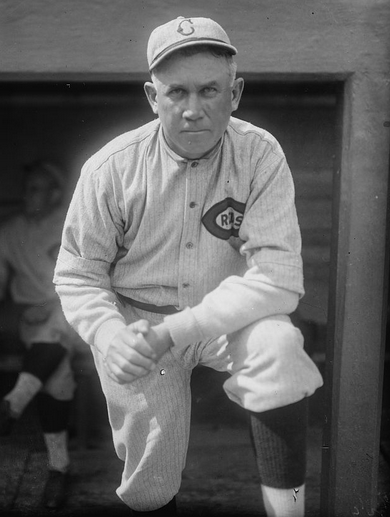
Speaking of karma fate played a role in Pat Moran arriving in Cincinnati. In 1918 World War 1 was raging in Europe and frankly the only reason the Allies won was the addition of fresh bodies in the form of the American Expeditionary Force. One of the many Americans drafted into service in that war was Reds Manager Christy Mathewson. Yes the same Christy Mathewson who was a Hall of Fame pitcher for the New York Giants(After being traded to the Giants by…guess who…the Reds! But I digress). He left the team in August 1918 to join the fight and somehow made it to the frontlines before the war ended in November. In January 1919 the Reds tried to contact Christy to see if he would be available for the upcoming season. But they couldn’t find him. It turns out Matthewson had been injured in the Ardennes Forest battle. The nature of the injury, whether regular battle or a gas attack, was unclear. Nonetheless he was in a military hospital in France when the Reds tried to get in touch with him. Since they couldn’t locate Christy Reds President Garry Herrmann decided they needed to move on without him. He saw a name that intrigued him. The Phillies had just fired the manager who had taken them to what, at that time, was their only World Series appearance. His name was Pat Moran. All Moran did was put together the best team Cincinnati had seen since the 1869 Red Stockings. Yes their World Series win over the White Sox is tainted by the “Eight Men Out” affair. But the fact is the Reds were the team that had the best record in baseball that year…not the more celebrated White Sox. Unfortunately we’ll never know what would have been had the Series been straight up. But nonetheless Moran brought Cincinnati it’s first World Championship. A championship the Reds will mark the centennial celebration of later this season. Moran’s Reds teams were always highly competetitive. But none ever reached the heights of the 1919 squad. Moran avoided the firing that the other managers I’ve mentioned suffered because he was called home by a higher power. Moran died during spring training in 1924. The Reds wouldn’t be a serious contender again for another 15 years.
Hitting Coach-Lou Piniella(1990-92)

The picture above is what people always remember about Lou as Reds manager. But there was so much more to his stay in Cincinnati. He took over in the wake of Pete Rose being banned from baseball for betting on the game. It was a low point for everyone involved with the franchise. Instead of coming in and commiserating with the team he gave them a swift kick in the ass. Apparently it was what they needed as the 90 Reds won their first 9 games. And though there were ups and downs along the way, including the classic base throwing scene above, the Reds never left first place. Not for one minute. one hour. one day. They won a fabulous NLCS in 6 games over the Pirates. And then they swept the A’s in a way that left the entire sports world stunned. Unfortunately Lou couldn’t keep the magic going. The 1991 squad never got going in large part due to the fact the team rushed Eric Davis back from the kidney injury he suffered in game 4 of the 90 World Series. And the 92 season was just off from start to finish. Which explains why the lasting memory of that season is the September clubhouse brawl between Piniella and Rob Dibble. Lou quit in a meeting with owner Marge Schott two days after that season ended. He bluntly told her he was pissed she hadn’t already renewed or extended his contract. Thankfully Lou is now associated with the Reds again as a Special Assistant to the G.M.
Pitching Coach-Fred Hutchinson(1959-64)
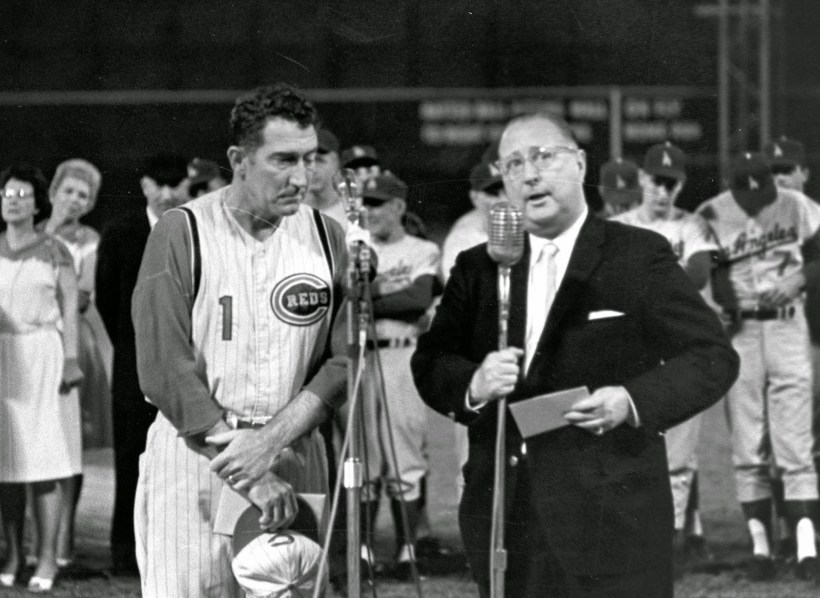
When you go to Great American BallPark you probably notice the list of retired numbers behind home plate. 5, Johnny Bench…8, Joe Morgan…10, Sparky Anderson…11, Barry Larkin…13, David Concepcion…14, Pete Rose…18, Ted Kluszewski…20, Frank Robinson…24, Tony Perez. Then there’s that number 1. Lots of people ask “Why is the number 1 up there?”. He’s why. Fred Hutchinson. Gabe Paul promoted him from the Reds’ AAA team in Seattle to manage the Reds in July 1959. In 1960 the new G.M. (and soon to be owner) Bill Dewitt Sr. gave him the job on a permanent basis. In 1961 he rewarded that decision by leading the Reds to the World Series where they would lose to the Yankees in 5 games. In 1962 his Reds won 98 games…AND FINISHED THIRD! The 1963 squad won 86 games and DeWitt extended Hutch’s contract through 1965. Unfortunately he wouldn’t make it that long. In December 1963 Hutch felt a lump on his neck. He visited his doctor brother in Seattle who found not one but multiple tumors in Fred’s lungs…in his chest…and in his neck. The diagnosis was lung cancer. And in 1963 that was a death sentence. He told the Reds but said he wanted to keep managing. The Reds told the public in January 1964. So everyone…fans, players, opponents…knew Hutch was going to die. That was the burden put on the shoulders of the 1964 Reds…Johnny Edwards, Gordy Coleman, Pete Rose, Leo Cardenas, Chico Ruiz, Bob Skinner, Vada Pinson, Frank Robinson, Jim Maloney, Jim O’Toole, a young Cuban named Tony Perez and the rest of that squad. They could have folded under pressure. But they dedicated their season to that man. Unfortunately they came up one game short of winning the NL title. But it doesn’t denigrate their effort in the least. To me that effort makes them one of the greatest teams in Reds history. Period. As for Hutch, he had to leave the dugout in August because the chemo was just too much for him. His last appearance at Crosley Field is the picture you see above. The Reds held a birthday celebration for their manager on August 12. His 45th birthday. The picture shows Reds owner Bill DeWitt Sr. addressing the crowd. When DeWitt finished speaking Reds Public Address Announcer Paul Sommerkamp invited the crowd to sing happy birthday to Hutch. The sellout crowd of nearly 30,000 in attendance at the corner of Findlay and Western that night sang “Happy Birthday” in unison. DeWitt openly sobbed on the field. Hutch officially resigned as Reds manager on October 19th. He died three weeks later in Bradenton, Florida. Pete Rose was traveling with teammate Chico Ruiz when he heard the news on the car radio that Hutch had died. Pete says he started crying. Hutch was named Sport Magazine’s “Man of the Year” for his courage in fighting cancer. But the lasting legacy of Hutch came the next year when his doctor brother opened the Fred Hutchinson Cancer Research Center in Seattle. Having lived out there I can tell you you can’t go into Seattle without seeing what is now simply known as Fred Hutch. If you want to join the fight against cancer I urge you to make a donation to Fred Hutch. Here’s a link to their website:
Donate to Fred Hutch – Fred Hutchinson Cancer Research Center
Bullpen Coach-John McNamara(1979-1982)

Mac had the unenviable task of replacing Sparky Anderson. Add to that no Pete Rose, Joe Morgan and George Foster injured, Ken Griffey Sr. lost to a knee injury and the odds looked dim for the 79 Reds. But thanks to the pitching of Tom Seaver, Tom Hume and Frank Pastore as well as the burst onto the scene of Dave Collins and Ray Knight, Mac somehow pushed the Reds to another NL Western Division title. They were swept by the “We are Family” Pirates in the playoffs. His best team took shape in 1981. That team, which featured Johnny Bench now platooning with Dan Driessen at 1B as well as Ron Oester now at 2b, compiled the best record in baseball. Unfortunately there was one minor detail. A players strike split the season into two halves. And while the Reds did have the best overall record in baseball, they didn’t win the division title in either half and thus missed the playoffs. Given how the strike and the season played out, Reds ownership decided it was time to cut payroll. After the 1981 season, Joe Nolan, Ray Knight, George Foster, Ken Griffey Sr. and Dave Collins were either traded or allowed to leave via free agency. Five of the eight starting position players were allowed to go. As you probably know, as a result of the those moves, the 1982 Reds were historically bad losing 102 games. But Mac wasn’t around to see the end. He was fired at the All-Star break. He deserved a better fate.
So that’s my team from top to bottom. Starters, backups, pitching staff and coaching staff. I hope you enjoy reading it even if you think I’m way off base. Regardless, lets enjoy this season and the celebration of 150 years of baseball in Cincinnati!










 ANSWERBUS.COM